Spend in the right order
Cheap Car Audio System: How to Build Good Sound on a Budget
Good budget car audio is not about buying the cheapest components. It is about fixing the biggest audible problem, preserving factory equipment that still works, planning the complete installed cost, and choosing upgrades that will still make sense later.
If the system has no real low bass, evaluate a subwoofer. If vocals and detail are muddy, investigate the front speakers and their installation. If decent speakers become harsh or distorted when you turn them up, amplification may be the missing piece.
If the existing system already sounds acceptable except for one weakness, leave the parts that are working alone.
Buy the next component only if another important limitation remains.
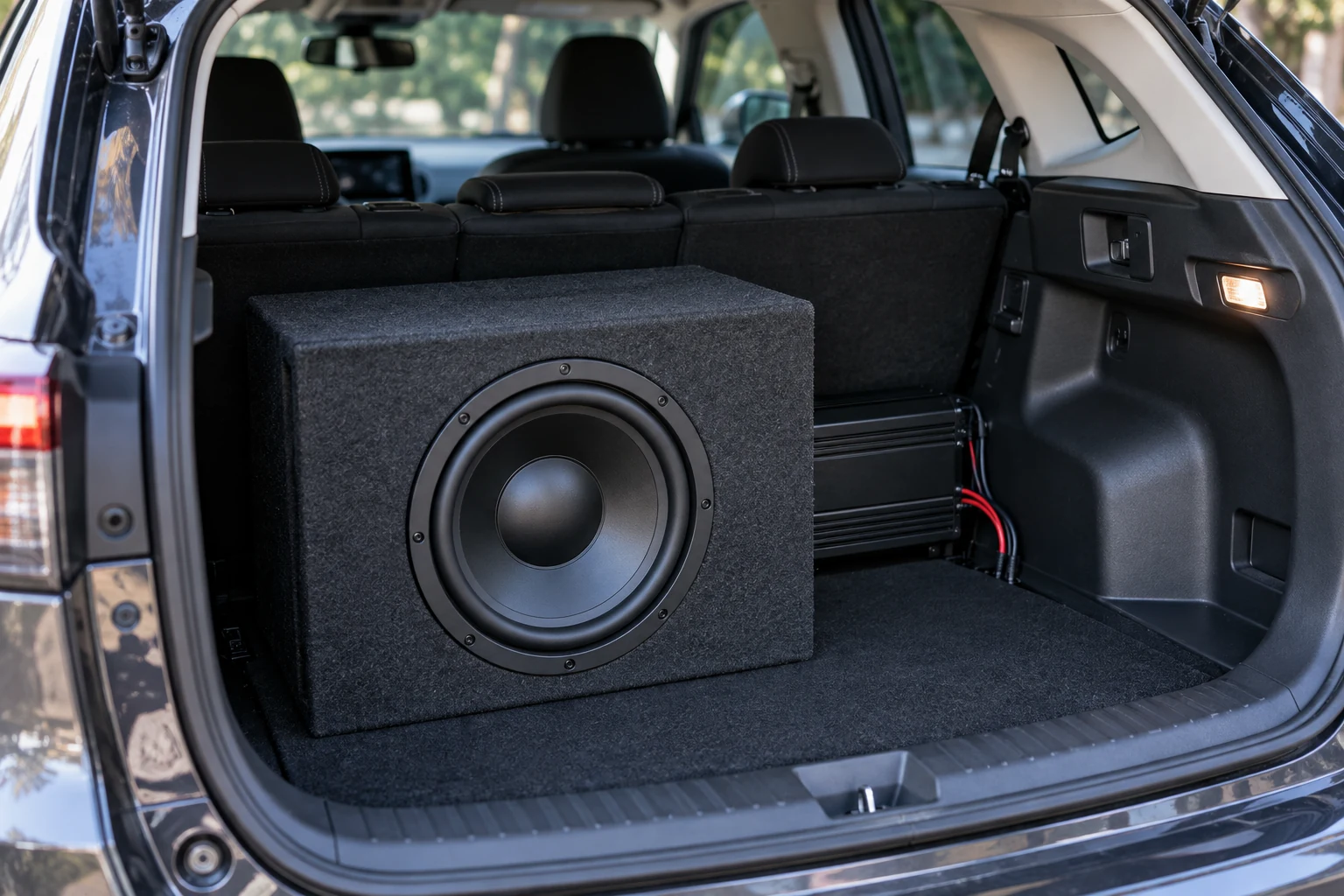
01 - Diagnose before buying
What should you upgrade first?
There is no universal first car-audio upgrade. Recent enthusiast discussions produce completely different answers - subwoofer, amplification, sound treatment, speakers, or DSP - depending on what is wrong with the original system. That disagreement is useful because it shows why "always replace the speakers first" is poor budget advice.
| What you hear now | Our first thing to investigate | What not to assume |
|---|---|---|
| Almost no low bass | Subwoofer | That new door speakers will create deep bass |
| Muddy vocals or poor detail | Front speakers and their installation | That more amplifier power alone will fix tonal problems |
| Distortion when volume rises | Source signal, amplification, gain structure | That larger speakers are required |
| Thin sound despite decent clarity | Subwoofer, door midbass, installation | That all four speakers need replacement |
| Weak midbass and rattling doors | Speaker mounting, sealing, vibration control | That expensive speakers are the cure |
| Missing Bluetooth, CarPlay, or source features | Head unit or compatible interface | That speakers are the priority |
| Aftermarket speakers sound worse than stock | Polarity, power, sensitivity, OEM processing, mounting | That you should buy another set immediately |
| Factory signal is heavily processed | Proper integration and possibly DSP | That a simple amplifier connection will behave normally |
Two questions recur throughout budget car-audio discussions: "what should I upgrade first?" and "why did my speaker replacement sound worse?"
The real budget question is not "where are the cheapest parts?" It is "how little can I spend and still get an obvious improvement without starting an expensive chain of secondary upgrades?"
02 - Price the complete job
A cheap system is about value, not the cheapest hardware
The easiest way to build a disappointing cheap system is to spend the entire budget on visible hardware.
A real installation can also require speaker brackets and wiring adapters, an amplifier wiring kit, power and ground cable, an appropriately sized fuse and fuse holder, RCA cables or speaker-level integration, a line output converter, a T-harness, speaker wire, a subwoofer enclosure, mounting hardware, foam or sealing materials, door treatment, trim tools and crimping tools, or professional labor.
Recent DIY budget discussions repeatedly expose these hidden costs. Crutchfield's amplifier installation documentation likewise treats power wire, ground wire, an inline fuse, signal wiring, remote turn-on wiring, and speaker connections as normal parts of an amplifier installation rather than optional accessories.
Our budget rule: before buying anything, avoid committing more than roughly 70 percent of the available money until you know what the remaining installation requires. This is not an industry formula. It is a practical way to keep a "$500 system" from becoming a $700 system before it plays its first song.
Budget examples that make sense
These are planning examples, not fixed shopping lists. Vehicle compatibility and current equipment prices can change the result significantly.
| Approximate all-in budget | What we would realistically target |
|---|---|
| $200-$300 | One focused improvement rather than a complete system |
| Around $500 | A meaningful first stage - for example, front-stage improvement or a bass-focused upgrade |
| $750-$1,000 | Enough room for a more balanced front stage, amplification, bass, and proper installation in many straightforward DIY builds |
| Above $1,000 | More flexibility for integration, DSP, professional labor, premium components, or more complicated vehicles |
A $300 budget is often more successful when it solves one obvious weakness than when it is divided among a cheap head unit, four cheap speakers, a cheap amplifier, and a cheap subwoofer.
Likewise, a $500 system does not have to be a "complete system." It can be stage one of a better $900 system. Crutchfield has long advocated building car audio systems in stages rather than treating the project as all-or-nothing, and recent enthusiast discussions continue to show the same budget behavior.
03 - Build around a goal
Our recommended budget-build strategy
- Identify what sounds wrong.
- Decide what "better" actually means.
- Set the complete installed budget.
- Keep every factory component that is not causing a problem.
- Choose the smallest upgrade that addresses the primary weakness.
- Check physical fit, RMS power, impedance, signal compatibility, and required accessories.
- Install it correctly.
- Set gain and crossovers correctly.
- Listen again using the same music and volume conditions.
- Buy the next component only if another important limitation remains.
This approach minimizes two expensive mistakes: replacing equipment that did not need replacement and buying temporary equipment that becomes useless at the next stage.
Four budget systems we would actually consider
The "better than stock" clarity build
Best for: a driver who is reasonably happy with the amount of bass but wants cleaner vocals, better detail, and less harshness.
Our preferred approach is to retain the factory head unit if its features are satisfactory, concentrate the speaker budget on the front stage, use speakers suited to the power actually available, budget for brackets, harnesses, sealing, and mounting, and add amplification later if clean output remains the limiting factor.
We would usually put front speakers ahead of rear speakers when money is tight and the driver is the primary listener. That is not because rear speakers are inherently bad. It is because putting the same money into the front stage, installation, amplification, or bass can deliver more benefit to the driver.
The "stock is fine except for bass" build
Best for: a factory system with acceptable vocals and treble but almost no satisfying low end.
Our preferred approach is to keep the factory radio and existing speakers, add a properly integrated subwoofer solution, choose a powered subwoofer when simplicity and space matter most, and choose a separate subwoofer and amplifier when future output and upgrade flexibility matter more.
Crutchfield specifically describes adding a subwoofer while keeping factory controls as a normal upgrade path. This is often a better use of a limited budget than replacing every door speaker merely because the system is missing bass.
The "cleaner and louder" build
Best for: a system that sounds acceptable at moderate volume but becomes strained, harsh, or distorted when pushed.
Our preferred approach is to diagnose the source and available power before replacing speakers. If the speakers are appropriate but are being asked to play loudly from a low-powered source, external amplification may offer the missing headroom. If the source itself clips or the speakers are already mechanically or thermally limited, adding amplifier power alone is not the solution.
Gain also matters. Gain is not a second volume control. It is used to match the amplifier's input sensitivity to the source. Incorrect gain settings can contribute to distortion and clipping.
The staged balanced build
Best for: someone who ultimately wants front speakers, amplification, and a subwoofer but cannot justify buying everything now.
Stage 1: front-stage improvement. Stage 2: amplifier and reusable wiring. Stage 3: subwoofer. Stage 4: optional DSP or additional treatment if a real problem remains.
The exact order can change. The important part is that stage one should still make sense when stage four exists.
04 - Avoid the speaker-swap trap
Why new speakers can sound worse than the factory speakers
A more expensive aftermarket speaker is not guaranteed to sound better when dropped into the same factory system.
Owners frequently report losing bass, getting brighter or harsher sound, or simply hearing less improvement than expected after a speaker-only replacement. It is one of the most common failure patterns in enthusiast discussions around budget upgrades.
Possible reasons include reversed speaker polarity, different impedance, lower effective sensitivity on the available power, inadequate amplifier power for the desired volume, poor mounting or an unsealed adapter, factory EQ or filtering designed around the original speakers, factory amplification, or expecting door speakers to replace a subwoofer.
Crutchfield advises matching speakers to the power source and emphasizes RMS power and sensitivity for low-powered factory systems. It also notes that modern factory integration can become substantially more complex when factory amplifiers and processed signals are involved.
Community reports are anecdotal rather than controlled tests, but recent examples show exactly the failure mode a budget buyer needs to recognize: an aftermarket speaker installation can sound worse than stock when the rest of the system is a poor match.
Before blaming the speakers
- Check polarity.
- Check mounting and the door seal.
- Check impedance.
- Check available power.
- Check source settings and EQ.
- Check factory filtering or amplification.
- Check crossover settings.
- Ask whether the missing "bass" is actually sub-bass that should be handled by a subwoofer.
Do that before buying another set.
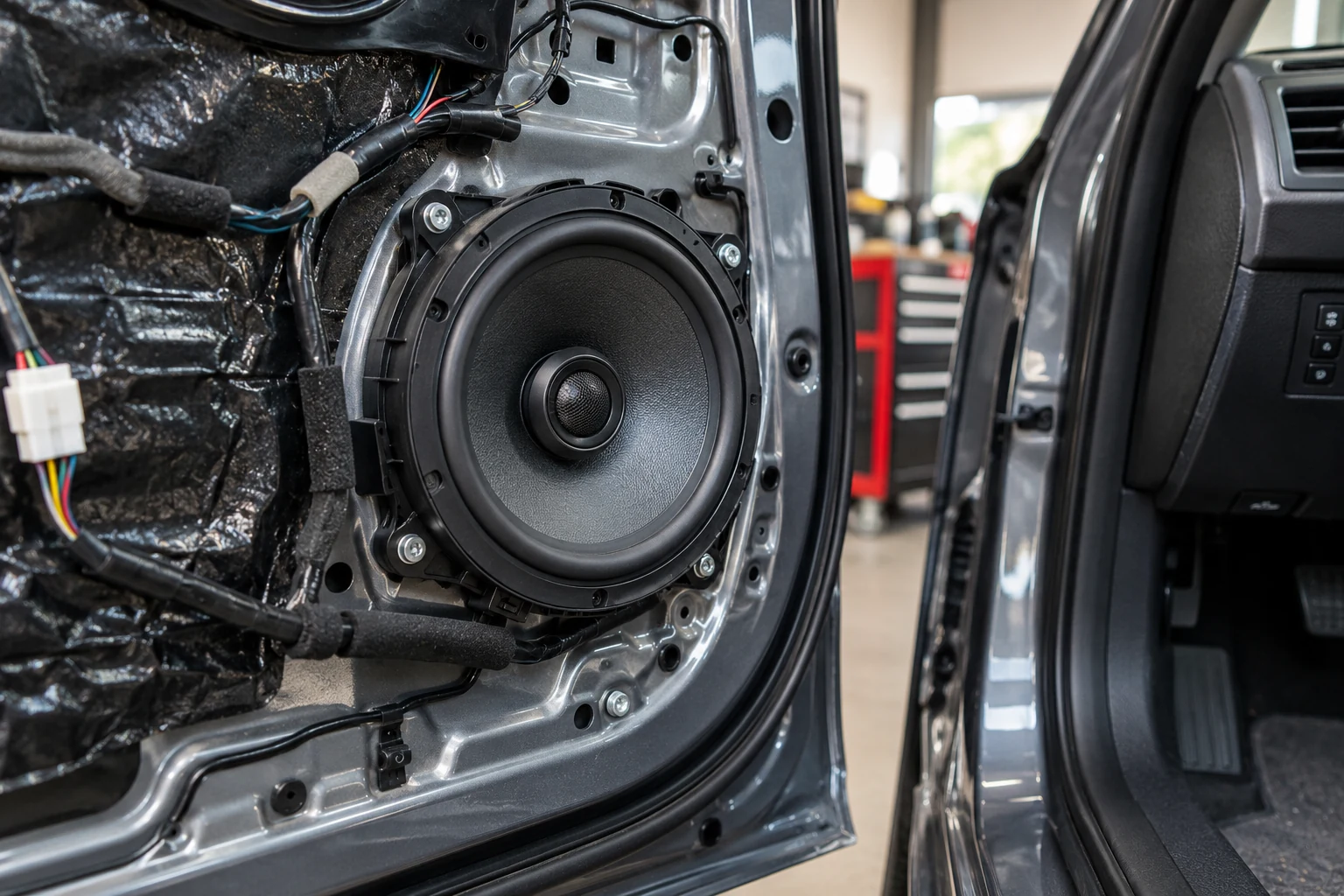
05 - Preserve useful factory hardware
Can you keep the factory head unit?
Yes - and in many budget builds, we prefer keeping it if it already provides the features the owner wants.
Replacing the factory radio simply because it is factory can consume money that would produce a larger audible benefit elsewhere.
Keeping it is especially attractive when the radio controls vehicle settings, cameras, climate functions, steering-wheel controls, factory displays, or integrated connectivity.
The catch is integration.
Factory radios often lack conventional RCA preamp outputs. Factory-amplified systems may also use signals that require appropriate speaker-level inputs, a line output converter, summing, or DSP-based integration. Crutchfield's current guidance distinguishes simple speaker-level connections from systems that need more sophisticated signal conversion, while AudioControl's OEM-integration equipment exists specifically to handle factory signal and load-matching problems.
The right question is not "Is a factory radio bad?" It is "Can I obtain a suitable signal from this factory system without destroying the budget or losing functions I care about?"
When should you replace the head unit?
We would move the head unit higher on the list when the existing radio is defective, Bluetooth or phone integration is a primary goal, CarPlay or Android Auto is a major reason for the project, the current source has limitations that cannot be handled economically through integration, or an aftermarket head unit meaningfully simplifies the planned amplifier system.
For an older basic vehicle, a new head unit can solve both feature and signal problems at once. For a newer integrated vehicle, it may be cheaper and cleaner to leave the dashboard alone.
06 - Choose the component that solves the problem
Speakers vs amplifier vs subwoofer
Choose speakers first when
- Clarity is the main complaint.
- Existing speakers are damaged.
- The tonal balance is poor.
- Mounting or speaker quality is clearly the limiting factor.
Choose an amplifier first when
- The current speakers are acceptable but need more clean output.
- Aftermarket speakers are already installed and under-driven for the intended use.
- A later system plan benefits from installing the power backbone now.
Choose a subwoofer first when
- The system is already clear enough but lacks low bass.
- Door speakers are being pushed too hard trying to reproduce bass.
- You want the largest tonal change without rebuilding the entire front stage.
Choose installation or door treatment first when
- The speaker mounting surface flexes.
- The door rattles.
- Midbass is weak despite otherwise appropriate equipment.
- Obvious installation defects are wasting the equipment you already own.
Consider DSP or integration first when
- The factory system splits or heavily processes signals.
- Factory EQ is working against the new equipment.
- Signal summing or correction is required.
- Tuning capability is solving a specific identified problem.
Our recommendation: there is no winner between speakers, amplifier, and subwoofer in isolation. The right choice is the component that removes the system's biggest audible bottleneck for the lowest complete cost.
07 - Ignore the marketing noise
The car-audio specifications that actually matter
You do not need to become an electrical engineer to shop intelligently. For a budget system, concentrate on a short list of specifications that affect fit, power, compatibility, and installation.
08 - Spend where the driver hears it
Speaker choices on a strict budget
Component speakers vs coaxial speakers
For a strict beginner budget, we often prefer good coaxial speakers installed properly rather than component speakers installed cheaply or incompletely.
| Factor | Coaxial | Component |
|---|---|---|
| Purchase cost | Usually lower | Usually higher |
| Installation | Simpler | More involved |
| Separate tweeter placement | No | Yes |
| Crossover complexity | Lower | Higher |
| Tuning potential | Lower | Higher |
| Budget beginner fit | Strong | Depends on goals and installation |
| Ultimate front-stage potential | Good | Generally higher |
Component speakers can offer better placement and system-building flexibility, but the potential advantage is wasted if buying the component set means you no longer have enough money for amplification, mounting, integration, or bass that matters more to the finished system.
Front speakers or all four?
For a driver-focused system with a tight budget, we normally prefer spending more on the front stage before automatically replacing the rear speakers.
That leaves more money for better front speakers, door installation, an amplifier, a subwoofer, wiring, or integration. But rear speakers are not forbidden. Replace or retain them according to whether rear passengers matter, whether you enjoy rear fill, whether the rear speakers are damaged, whether DSP tuning will use them intentionally, and what the same money could improve elsewhere.
A dogmatic "never use rear speakers" rule is no more useful than "always replace all four."
Do you need an amplifier for aftermarket speakers?
Not always. Many aftermarket speakers can operate from head-unit power. The more important question is whether they perform satisfactorily at the listening level you want with the power available.
Crutchfield's 2026 speaker FAQ says most of its aftermarket speakers can operate from factory power, while also noting that external amplification lets appropriate speakers perform closer to their intended capability.
Consider an amplifier when the speakers require more clean power for the volume you want, the existing source clips before you reach the desired output, the system plan needs better control and headroom, or the amplifier will remain useful through future stages. Do not add an amplifier simply because "real systems have amps."
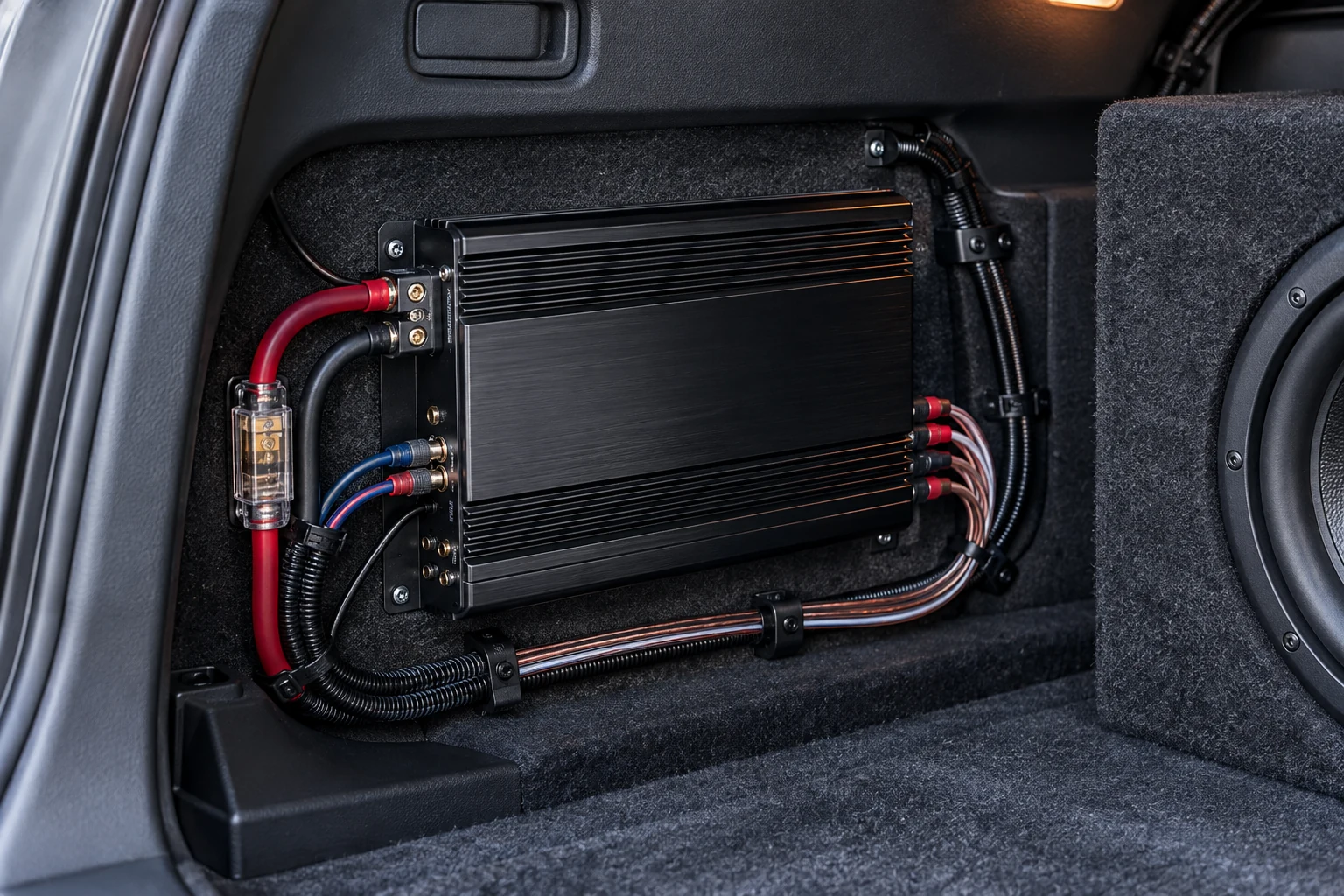
09 - Add bass without buying the wrong architecture
Powered subwoofer vs separate subwoofer and amplifier
A powered subwoofer combines the woofer and amplifier into one product. That makes it attractive when the main priorities are simple installation, predictable packaging, less occupied space, fewer separate parts, and moderate bass rather than maximum output.
A separate subwoofer and amplifier normally makes more sense when the priorities are greater output potential, more enclosure choices, easier component replacement, future upgrades, or more control over power and subwoofer selection.
| Decision | Powered sub | Separate sub + amp |
|---|---|---|
| Simplicity | Better | Worse |
| Number of parts | Fewer | More |
| Compact installation | Often better | Depends |
| Maximum upgrade flexibility | Lower | Higher |
| Maximum output potential | Usually lower | Usually higher |
| Beginner friendliness | Better | More planning required |
| Future component reuse | Limited | Better |
We prefer a powered sub when "enough bass with minimal hassle" is the job. Choose separate components when this is clearly the beginning of a larger system.
One decent subwoofer or multiple cheap subs?
For a budget system, we would normally rather buy one appropriately matched, properly installed subwoofer than spend the same budget trying to maximize cone count. Two cheap drivers also mean more enclosure space, more total power demand, more complicated impedance decisions, potentially more amplifier cost, and more installation requirements.
A subwoofer should be judged as a system: driver + enclosure + amplifier + impedance + wiring + space, not by cone diameter or the number printed on the box.
The enclosure is part of the subwoofer system
Do not budget for a raw subwoofer and treat the enclosure as packaging. The enclosure affects physical fit, occupied cargo space, low-frequency behavior, installation complexity, and total cost.
If you buy a raw subwoofer, verify that it is suitable for the enclosure you intend to use. For a first budget system, a compatible loaded enclosure can remove a large amount of guesswork.
10 - Solve acoustic and signal problems only when they are real
Sound deadening and DSP
Sound deadening: worth it?
Sometimes very much so. But "sound deadening" is an imprecise phrase.
For car-audio purposes, constrained-layer damping material is mainly used to reduce panel resonance and vibration. It can help create a more stable environment for a door speaker and reduce rattles. It is not the same thing as fully blocking outside road noise.
ResoNix's technical guide makes that distinction explicitly: constrained-layer damping is intended to control structure-borne panel resonance, while blocking external noise requires different materials and treatment.
We would prioritize door treatment when the outer door skin visibly resonates, the panel rattles, speaker mounting is poor, midbass lacks solidity, or the existing speakers appear capable but the door is wasting their output. We would not automatically reserve a fixed percentage of every system budget for deadening.
Do you need a DSP?
No - not automatically.
DSP can provide equalization, crossover control, time alignment, signal summing, level control, and correction for some factory-system problems. AudioControl's current product documentation shows how DSP and OEM-integration hardware can handle signal processing, factory integration, and bass-correction tasks.
But a DSP is poor value when the actual problem is simply a blown speaker, missing sub-bass, a loose door panel, or an amplifier installation that has not been set up correctly.
For a cheap system, ask: "What specific problem is the DSP buying its way out of?" If the answer is unclear, spend the money elsewhere.
11 - Stretch the budget without buying someone else's problem
New vs used car audio
Used equipment can be one of the best ways to stretch a limited budget, but only when the extra risk is worth the savings.
We are most comfortable buying used when
- The model has a good service history and documentation.
- The seller allows a functional test.
- Terminals and controls are intact.
- There is no obvious water, corrosion, or heat damage.
- The price difference is large enough to justify losing some warranty protection.
Check a used amplifier for
- Damaged terminals.
- Burnt smell.
- Corrosion.
- Intermittent operation.
- Protection-mode behavior.
- Loose controls.
- Evidence of previous repair.
- The ability to test all channels.
Check a used subwoofer for
- Torn surround.
- Damaged cone.
- Burnt smell.
- Scraping or rubbing during careful cone movement.
- Damaged terminals.
- Obvious coil or suspension problems.
| Factor | New | Used/refurbished |
|---|---|---|
| Purchase risk | Lower | Higher |
| Warranty | Usually stronger | Variable |
| Price | Higher | Lower |
| Equipment tier for the same budget | Lower | Potentially higher |
| Condition certainty | Higher | Lower |
| Need for testing | Lower | Higher |
Our view: used higher-tier gear can be better value than brand-new bargain-basement gear, but "used" is not automatically a bargain.
12 - Do not fake the infrastructure
Wiring, electrical capacity, and installation
Wiring is not where we would fake the budget
Amplifier power wiring has to carry electrical current safely. The required gauge depends on system current demand, run length, conductor material, and the manufacturer's specifications. Crutchfield's current wire-sizing guide also notes that copper-clad aluminum does not carry the same current as the same gauge of copper conductor.
More importantly, the amplifier power cable must be appropriately fused near the battery. The fuse protects the power wire and vehicle if the cable shorts to the chassis. That is not an area where a "2000W" label on an inexpensive wiring kit tells you much.
We would rather use less amplifier power with correct wiring than claim more amplifier power through an inadequate installation.
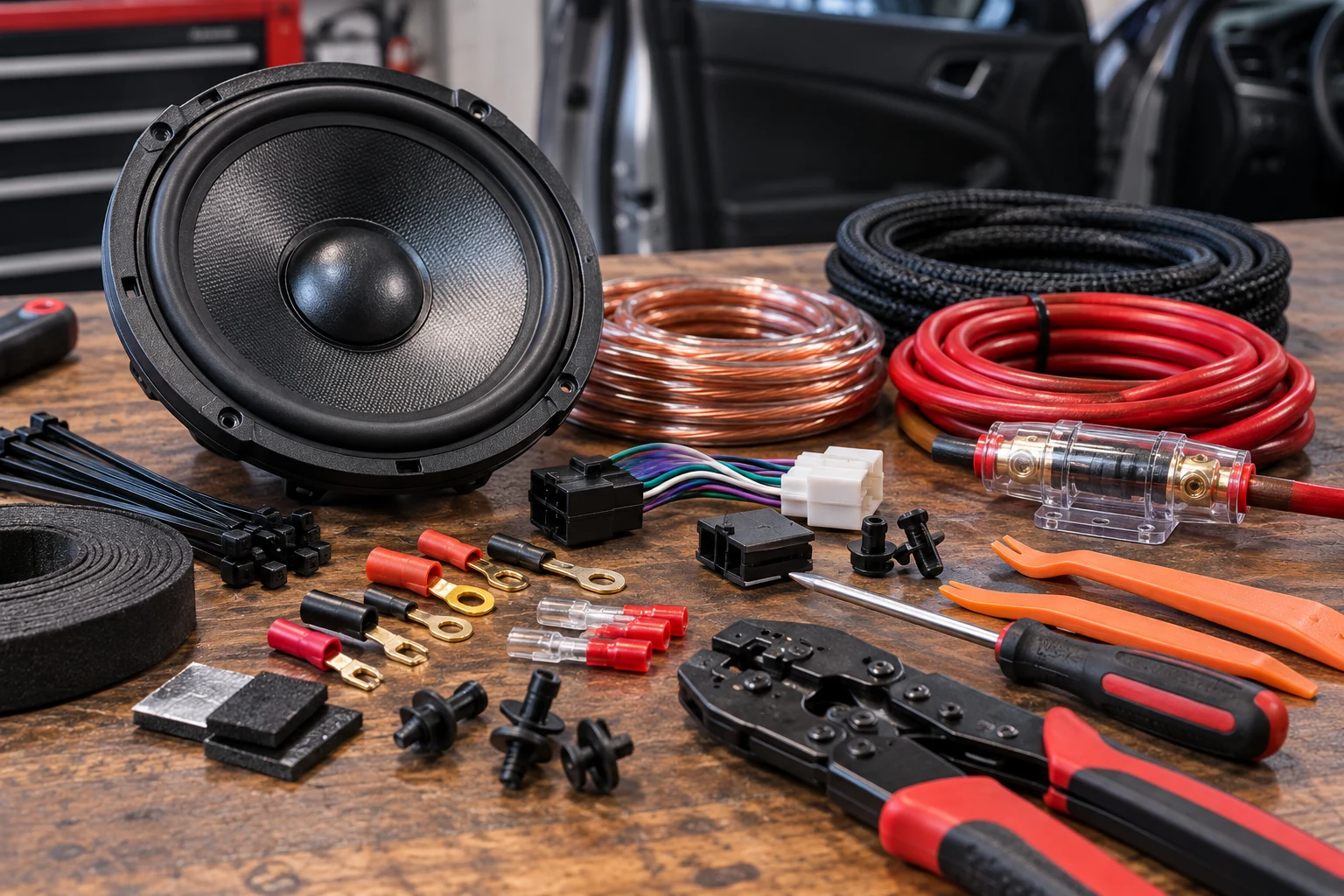
Do you need an electrical upgrade?
Most modest budget systems should begin with the existing electrical system unless there is evidence that it cannot support the planned load.
Do not use a universal statement such as "Stock electrical is safe up to X watts." Vehicles differ in alternator capacity, charging strategy, idle output, existing electrical loads, battery condition, wiring, amplifier efficiency, and how the system is actually used.
As power demand rises, electrical infrastructure can become a major part of the project. At that point, the build may no longer qualify as cheap.
If the planned amplifier system creates voltage problems or demands electrical upgrades that consume a major part of the budget, reconsider the system size before treating the electrical upgrade as an afterthought.
DIY or professional installation?
DIY saves labor money only when you can complete the work correctly.
Good DIY candidates include jobs where you have reliable vehicle-specific information, can remove panels without damaging them, can crimp and terminate wiring correctly, understand battery safety and fusing, can identify factory signal wiring, and have enough time to troubleshoot.
Professional installation becomes more attractive when the factory system is heavily integrated, modules or factory amplifiers must be retained or bypassed, significant trim disassembly is required, you need fabrication, the signal path is unclear, or the financial consequence of a mistake is high.
The correct budget question is therefore: "Does my budget include labor?" not merely "How much do the speakers cost?"
13 - Make modest hardware work properly
Basic installation and tuning matter more than another logo
A modest component installed properly can outperform a more expensive component installed carelessly.
Speaker polarity
Reversed polarity between speakers can weaken bass and damage imaging.
Mounting and sealing
The speaker should be mounted securely. Loose adapters and door panels can resonate, and air leaking around a poorly mounted door speaker can hurt midbass performance.
Grounding and fusing
Amplifier grounds must be electrically sound, and power cable must be protected with an appropriate fuse near the battery. Crutchfield identifies poor ground connections as a major source of amplifier noise problems.
Set the gain correctly
Amplifier gain is not a loudness knob. Its purpose is to match the amplifier input to the signal coming from the source.
- Establish the highest clean source level.
- Start with amplifier gain low.
- Use appropriate test material or measurement.
- Increase gain until the amplifier reaches the desired clean output.
- Back away from audible or measured clipping.
Crutchfield's gain-setting guide demonstrates the use of test tones for finding the source's clean output level and then matching amplifier gain to it. If you do not understand the procedure for your equipment, follow the amplifier manufacturer's setup instructions rather than copying a random gain-knob position from somebody else's system.
Use crossovers instead of asking every speaker to do everything
Basic crossover settings help different drivers stay in the frequency ranges they can reproduce effectively. In a conventional amplified system, a high-pass filter can keep deep bass out of door speakers, and a low-pass filter can keep midrange and treble out of the subwoofer.
The exact crossover point depends on the speakers, subwoofer, enclosure, vehicle, slope, and system goals. We do not recommend copying one frequency as a universal answer.
14 - Shop in the right order
A better way to shop for budget equipment
Budget speakers
- Does it physically fit?
- Is the impedance appropriate?
- Will it work well with the available power?
- Is sensitivity suitable for the intended power source?
- Does the speaker type match the installation?
- What additional installation hardware is required?
- Will it remain useful if an amplifier is added later?
- Then compare price and brand.
Do not reverse that order and start with "Which famous brand has the biggest discount?"
Budget amplifier
- Real RMS output at the intended impedance.
- Correct channel count.
- Compatibility with the speakers or subwoofer.
- Appropriate inputs for the source.
- Current demand and wiring requirements.
- Crossover and setup features actually needed.
- Physical size and cooling.
- Future usefulness.
- Price.
A large "MAX POWER" number does not move an amplifier higher on our list.
Budget subwoofer
- What kind of bass you want.
- How much space you can lose.
- Whether you want a powered or separate system.
- RMS power.
- Impedance.
- Enclosure requirements.
- Total amplifier and wiring cost.
- Upgrade plans.
Do not buy the largest subwoofer that fits the remaining cash.
16 - Measure success against the original problem
How to know whether the upgrade worked
Use the problem that started the project as your test. If you started because vocals were muddy, listen to familiar vocal tracks before and after. If the system lacked bass, compare low-frequency extension and balance. If distortion at higher volume was the problem, compare clean usable volume. If the doors rattled, listen for the same rattles.
The problem is solved
Stop. This is the most underrated budget-audio advice.
The problem is mostly solved
Try installation and tuning changes before buying more equipment.
A second weakness is now obvious
That becomes the next stage.
Nothing meaningful improved
Check compatibility and installation before assuming you need better equipment.
It sounds worse
Diagnose the system before buying anything else.
17 - Stop when the original job is done
Our final budget-build recommendation
For most people who want good sound without turning car audio into a hobby, we recommend building the smallest system that fixes the largest audible problem and leaves a sensible upgrade path.
That may mean replacing only the front speakers. It may mean leaving every factory speaker alone and adding a powered subwoofer. It may mean adding an amplifier to equipment you already own. It may mean spending money on installation instead of hardware.
And in a heavily processed modern factory system, it may mean doing nothing until you understand the integration cost.
Cheap car audio is not about buying the most equipment for the least money. It is about buying the least equipment necessary to get the result you actually wanted.
Research note
How we researched this guide
This article combines current technical documentation with enthusiast discussions used as anecdotal evidence about real-world problems.
For technical claims about speaker power, sensitivity, amplifier wiring, subwoofer matching, factory-system integration, and amplifier setup, we prioritized current technical and installation material from established car-audio sources. Community discussions were used to identify recurring questions and failure modes, not to establish universal technical rules.
Across the material reviewed for this guide, recurring concerns included disappointing speaker-only upgrades, hidden installation costs, OEM integration, staged builds, and deciding which component should be upgraded first.
We did not physically test every configuration discussed in this guide, and we do not claim that one build architecture works for every vehicle.
Frequently asked questions
Cheap car audio questions, answered
How much should I spend on a cheap car audio system?
There is no minimum amount that guarantees good sound. A small budget is usually most effective when it solves one problem well rather than trying to replace the entire system. Around $500 can fund a meaningful DIY stage in many vehicles, but the actual result depends heavily on integration, installation hardware, existing equipment, and the goal.
What is the best first car-audio upgrade?
The best first upgrade is the one that addresses the biggest audible weakness. Choose a subwoofer for missing low bass, front speakers for clarity problems, amplification when appropriate speakers need more clean output, a head unit when source features are the problem, and installation treatment when rattles or poor mounting are wasting existing equipment.
Should I replace the speakers first?
Not automatically. A speaker replacement makes sense when the existing speakers are damaged or when front-stage clarity is clearly the limiting factor. A speaker-only upgrade can disappoint if the factory system uses unusual impedance, limited power, aggressive processing, or poor installation conditions.
Will aftermarket speakers sound better with a factory radio?
They can, but not every aftermarket speaker is a good match for factory power. Physical fit, impedance, sensitivity, power requirements, factory processing, and installation all matter. Crutchfield specifically recommends considering power handling and sensitivity when choosing speakers for factory-powered systems.
Why did I lose bass after replacing my factory speakers?
Possible causes include reversed polarity, different speaker efficiency, reduced low-frequency output from the new speakers, installation leaks, insufficient power, or factory processing designed around the original speakers. Do not assume the new speakers are defective until those possibilities have been checked.
Do I need an amplifier?
Not always. Add an amplifier when the desired speakers or listening level require more clean power than the existing source can provide, or when amplification is part of a planned upgrade path. Do not buy one merely because aftermarket systems are "supposed" to have one.
Do I need a subwoofer for good sound?
Not every listener needs one, but a subwoofer is normally the appropriate tool when the goal includes genuine low bass. Door speakers are primarily responsible for the front stage and midbass, and asking them to provide deep bass can compromise the rest of the system.
Is a powered subwoofer worth it?
A powered subwoofer is worth considering when simplicity, compact packaging, and predictable installation matter more than maximum output and future flexibility. We prefer separate subwoofer and amplifier components when the owner already expects to upgrade significantly later.
Are component speakers worth the extra cost?
They can be when front-stage quality, tweeter placement, and future tuning matter enough to justify the additional cost and installation. For a strict beginner budget, a well-chosen coaxial installed correctly can be better value than an ambitious component set that consumes money needed elsewhere.
Should I replace the rear speakers?
Not necessarily. For a driver-focused build, we normally prioritize the front stage first. Rear speakers become more important when rear passengers, rear fill, or the particular system design makes them valuable.
Is sound deadening worth it?
It can be, particularly when doors resonate, rattle, or provide a poor acoustic environment for the speakers. Vibration damping should not be confused with complete road-noise isolation, which requires a more extensive material strategy.
Do I need DSP in a budget system?
Only when DSP solves a real problem that less expensive equipment cannot solve effectively. Modern factory processing, signal summing, equalization, and time alignment can justify DSP, but a simple aftermarket system can work without one.
Is used car-audio equipment worth buying?
Used equipment can offer excellent value if it can be inspected and tested. The savings should be large enough to compensate for uncertain condition, limited warranty coverage, and the possibility of repair or replacement.
What is more important, RMS or peak watts?
For normal equipment matching, RMS is far more useful. RMS specifications describe continuous power handling or output, whereas large peak or maximum-power figures are a poor basis for designing a system.
Does speaker sensitivity matter?
Yes, particularly when the speakers will be powered by a relatively low-powered factory or aftermarket head unit. Sensitivity helps indicate how much output a speaker produces from the power applied, but it is not a sound-quality score.
Can I add an amplifier while keeping the factory radio?
Usually, but the integration method depends on the vehicle. Some systems can feed an amplifier through compatible speaker-level inputs, while others require a line output converter, signal summing, a vehicle-specific interface, or DSP.
Can I build a good system for $500?
A $500 all-in budget can produce a worthwhile improvement when the project is focused and much of the work is DIY. It is less realistic as a universal promise for a complete speakers-plus-amplifier-plus-subwoofer-plus-installation system. Recent enthusiast discussions around $400-$500 builds consistently show how wiring, integration, mounting hardware, and other extras consume part of the apparent hardware budget.
When should I stop upgrading?
Stop when the problem that caused you to start spending money has been solved to your satisfaction. A budget system does not become better merely because it contains more aftermarket equipment.
References
Sources and references
- Crutchfield - Car Speakers FAQ
- Crutchfield - Car Speakers Buying Guide
- Crutchfield - How to Match Subwoofers and Amplifiers
- Crutchfield - Car Amplifier Installation Guide
- Crutchfield - Speaker-Level Inputs or Line Output Converter?
- Crutchfield - How to Set Amplifier Gain Using Test Tones
- Crutchfield - Budget-Friendly Car Audio Setup
- Crutchfield - Adding an Amplifier to a Factory Stereo
- Crutchfield - Car Amplifier Wire Gauge Chart
- Crutchfield - Car Amplifier Power Wire Fuses
- Crutchfield - Car Amplifier Installation Questions
- ResoNix - Sound Deadening Materials Reference Guide
- AudioControl - DM-810 OEM Integration and DSP Features
- Reddit r/CarAV - "Most bang for your buck" discussion
- Reddit r/CarAV - $500 DIY setup discussion
- Reddit r/CarAV - Aftermarket speaker troubleshooting discussion
Community discussions are used as anecdotal context only. Technical specifications and installation guidance are prioritized from manufacturer or established technical documentation.